


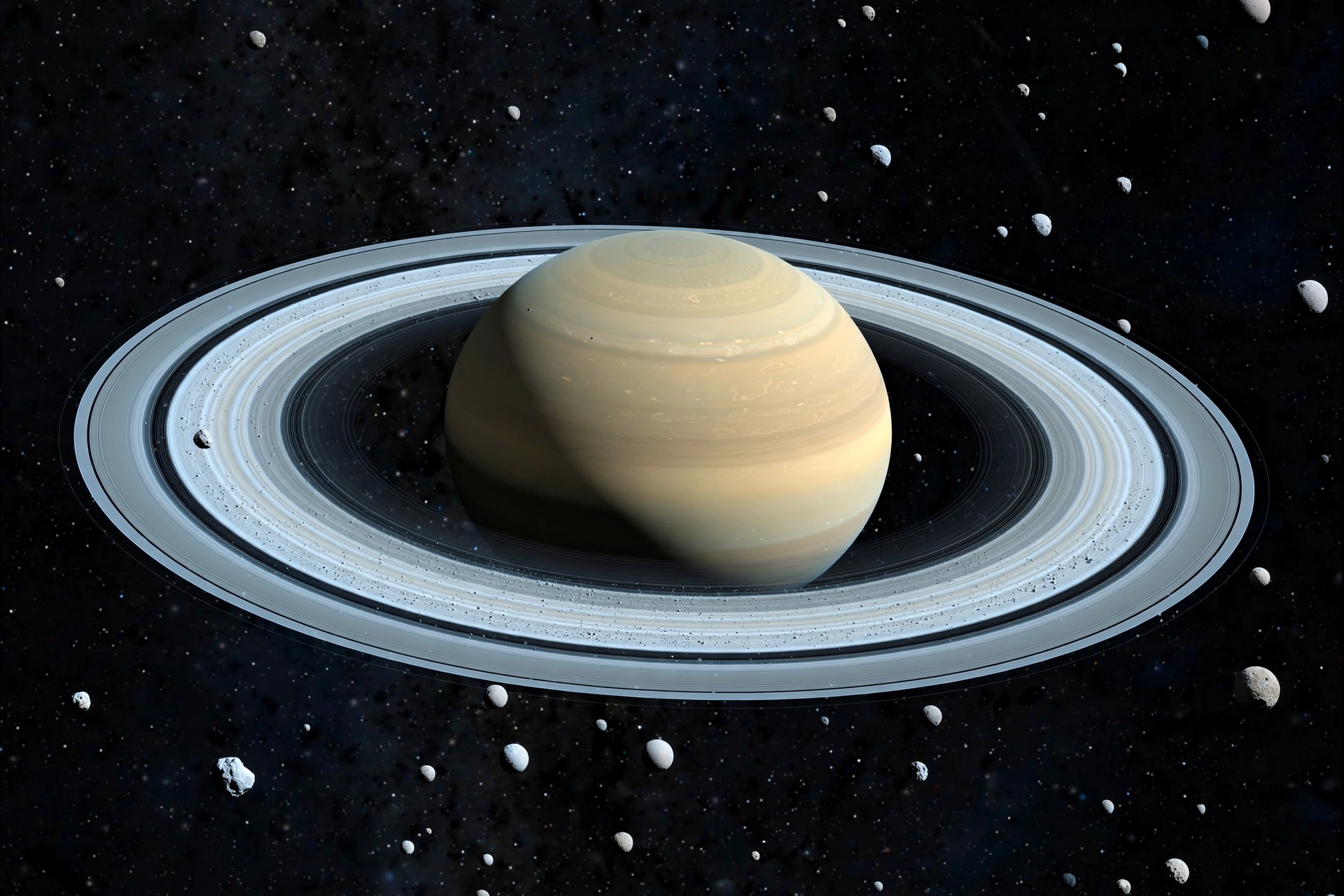
Every few years, a survey quietly rewrites a number everyone thought was settled. This time the number belongs to Saturn: astronomers have confirmed 128 new moons, bringing the planet’s total to 274 — more than all the other planets in the solar system combined, and almost double the previous figure of 146.
For a tech audience, the discovery is a case study in how modern instruments plus modern data processing extract value from observations gathered over years. No single night at the telescope produced this result. A long, methodical survey did, using a technique that stacks faint signals until the invisible becomes measurable.
Inside the survey
The observations were made with the Canada-France-Hawaii Telescope on Mauna Kea, Hawaii, by a team that included University of British Columbia researcher Dr Edward Ashton. Over several years the astronomers imaged the region around Saturn repeatedly, hunting for objects so faint that each one, alone, would be indistinguishable from noise.
The processing method, shift and stack, is the engine of the discovery. Because Saturn’s moons move with the planet at a predictable rate, software can shift each frame to compensate for that motion before combining dozens of exposures. A genuine moon’s light accumulates into a solid detection; artefacts and background stars do not align and fade away. Candidates were then followed until their orbits could be calculated precisely enough for recognition by the International Astronomical Union.
The telescope’s own site, CFHT, documents the instruments that make such deep, wide-field surveys possible.
Tiny moons, tilted orbits
Set aside any image of new worlds like Titan. The confirmed moons are irregular satellites a few kilometres across, orbiting far from Saturn on paths tilted sharply relative to the planet’s equator. Many are retrograde, travelling around Saturn opposite to its rotation.
Those characteristics point to capture rather than birth. Objects formed with Saturn would share its orderly rotation. Objects seized later by its gravity keep the disorder of their arrival. In planetary science, an orbit is a historical document, and these 128 documents describe interlopers collected over the age of the solar system.
It is a reminder, familiar from our coverage of how new imaging is changing cancer detection, that better ways of seeing tend to revise what we thought we knew — in a clinic or at the edge of a planetary system.
Families made by collisions
Perhaps the most revealing pattern in the data is family resemblance. Groups of the new moons share similar orbits, strongly suggesting they were once single, larger moons that broke apart. Collisions in Saturn’s distant retinue would have scattered fragments along related paths, where they remain today.
Counting and mapping those fragments turns the catalogue into a timeline. Researchers can work out which groups exist, how dispersed each group is, and from that infer when break-ups occurred and how big the parent bodies were. Saturn’s outer system becomes legible as a sequence of captures and smash-ups rather than a static collection of rocks.
How far could the count go?
There is little reason to treat 274 as a ceiling. Detection limits are set by telescope sensitivity and processing, both of which keep improving. Smaller fragments almost certainly remain below the current threshold. Similar survey effort directed at the other giant planets would likely lift their totals too, although Saturn’s combination of mass, history and observing attention makes its lead formidable.
For now, the practical outcomes are a vastly richer dataset for modelling how giant planets acquire their satellite systems, and a fresh set of targets and groupings for theorists to explain. The glamorous part of astronomy is discovery night. This discovery belonged instead to the archive, the algorithm and the long follow-up — the unglamorous machinery that, increasingly, is where astronomy actually happens.
A note on the naming to come
Confirmed moons eventually receive official names, drawn for Saturn’s irregular satellites from mythological traditions, following conventions overseen internationally. That process will take time, and for research purposes the provisional designations are what matter: they tie each object to its measured orbit. Even unnamed, the 128 are now part of the permanent record, available for every future model of the Saturn system to account for — which is precisely why the confirmation step, rather than the first detection, is the moment that counts.

1 Comment
Pingback: What Is Dutch Disease? The Gas Boom That Squeezed Dutch Manufacturing - Tech Waterfall