


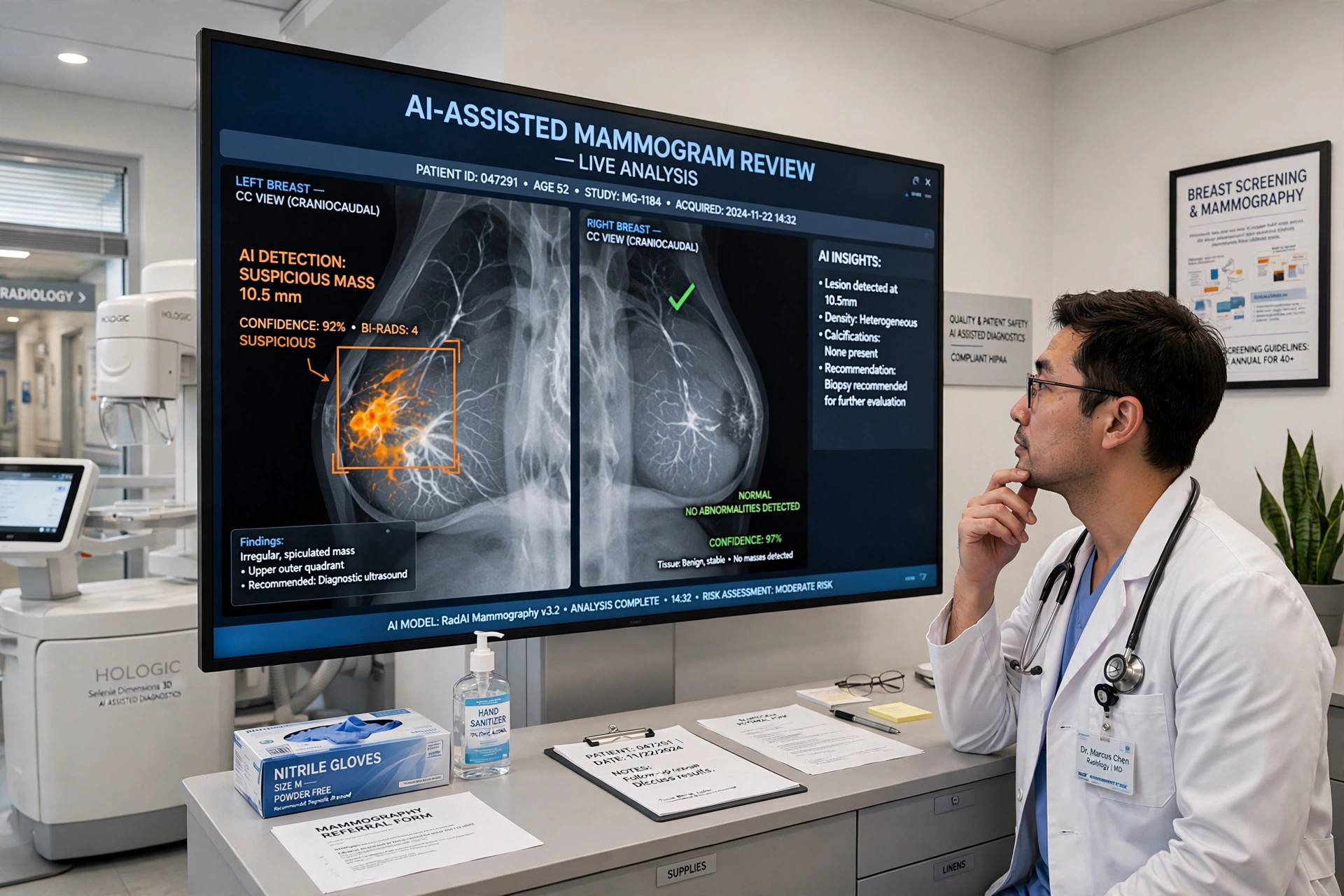
Breast cancer outcomes depend heavily on one thing: how early the disease is found. Cancers detected at an early stage are generally far easier to treat, with more options and better survival, than those found after they have spread. That is why a wave of new technology, from artificial intelligence that reads mammograms to more advanced imaging, is drawing so much attention from doctors, researchers and patients alike.
The discussion, highlighted recently among science and health communities online, reflects a genuine shift in screening. AI systems are now being tested and deployed alongside radiologists, new imaging methods are producing clearer pictures of dense breast tissue, and risk tools are helping identify who may benefit from earlier or more frequent checks. According to the World Health Organization, breast cancer is the most common cancer in women worldwide, which makes even modest improvements in detection significant at a population level.
AI as a Second Pair of Eyes
A mammogram is not a simple photograph. Radiologists must spot subtle patterns in complex images, sometimes among dense tissue that can hide a tumour or mimic one. AI software trained on large collections of previous scans can flag areas that deserve a closer look, acting as a second reader that never gets tired at the end of a long clinic.
Studies of these systems have reported encouraging results, including catching some cancers that were missed on an initial human read and helping prioritise the most urgent cases in a queue. Just as importantly, AI can reduce false alarms in some settings, sparing patients the anxiety and extra procedures that follow a callback for something that turns out to be harmless. It is not replacing radiologists; the strongest results tend to come when human expertise and software work together.
Readers who follow technology coverage on Tech Waterfall will recognise the pattern from other fields, and coverage of Qualcomm’s latest mobile chip shows how quickly on-device intelligence is advancing in consumer devices too. Medicine is applying similar ideas, with far higher stakes and far stricter testing.
Imaging That Sees More
Alongside AI, the pictures themselves are getting better. Three-dimensional mammography, known as tomosynthesis, takes images from multiple angles and builds a layered view, making it easier to see through overlapping tissue. Contrast-enhanced mammography and faster, more detailed MRI techniques are also being used, particularly for people at higher risk or with dense breasts, where standard screening can be less effective.
The National Cancer Institute notes that screening aims to find cancer before symptoms appear, and explains the benefits and limitations patients should understand. New imaging does not remove those trade-offs entirely, but clearer images can mean fewer missed cancers and fewer unnecessary recalls, both of which matter enormously to the people in the waiting room.
Smarter, More Personal Screening
Another change is in who gets screened, and how often. Instead of relying almost entirely on age, newer risk models combine family history, genetics, breast density and other factors to estimate an individual’s risk. That could mean earlier or more intensive screening for those at higher risk, and less frequent screening for those at very low risk, making programmes both safer and more efficient.
Technology is also reaching beyond big hospitals. Portable imaging, remote reading of scans and AI triage could help clinics in rural or low-resource areas, where a shortage of specialist radiologists can delay diagnosis. Getting a suspicious scan reviewed quickly, wherever a patient lives, is one of the most practical promises of these tools.
What It Means for Patients
For patients, the message is encouraging but grounded. If you are invited for screening, attending still matters more than any single piece of technology, because AI and advanced imaging only help when the scan actually happens. Know what is normal for you, report changes promptly, and ask your care team whether your breast density or family history affects the type of screening you should have.
There are limits to keep in mind. New tools must be validated carefully, work fairly across different populations, and fit into real clinical workflows without adding cost or delay. Regulators and health systems are moving deliberately for exactly those reasons.
Even so, the direction is clear. Earlier, more accurate detection saves lives, and the combination of AI, better imaging and personalised risk assessment is pushing breast cancer screening firmly in that direction.

2 Comments
Pingback: 128 New Moons Found Around Saturn by Deep Telescope Survey - Tech Waterfall
Pingback: NeoVax Plus Nivolumab: What the Ovarian Study Found - Tech Waterfall