


What if a cancer vaccine were not pulled from a shelf but built, one patient at a time, from the mutations inside that patient’s tumour? That is the premise of NeoVax, and a phase 1 trial published in Nature Medicine has now tested it — together with the checkpoint inhibitor nivolumab — in people with platinum-sensitive recurrent ovarian cancer.
The results are best described as a successful rehearsal. The personalised vaccines could be manufactured and given, the combination’s safety was acceptable, and testing showed T-cell responses. The trial was not designed to show that the treatment fights cancer effectively, and it does not. In a field vulnerable to inflated headlines, that boundary is the most important line in the study.
Designing a vaccine from tumour DNA
Cancer cells carry mutations, and some of those mutations create neoantigens — protein fragments found on tumour cells but not on healthy ones. NeoVax begins by analysing a patient’s tumour to find those fragments, predicts which are most likely to attract immune attention, and manufactures a vaccine encoding the selected targets.
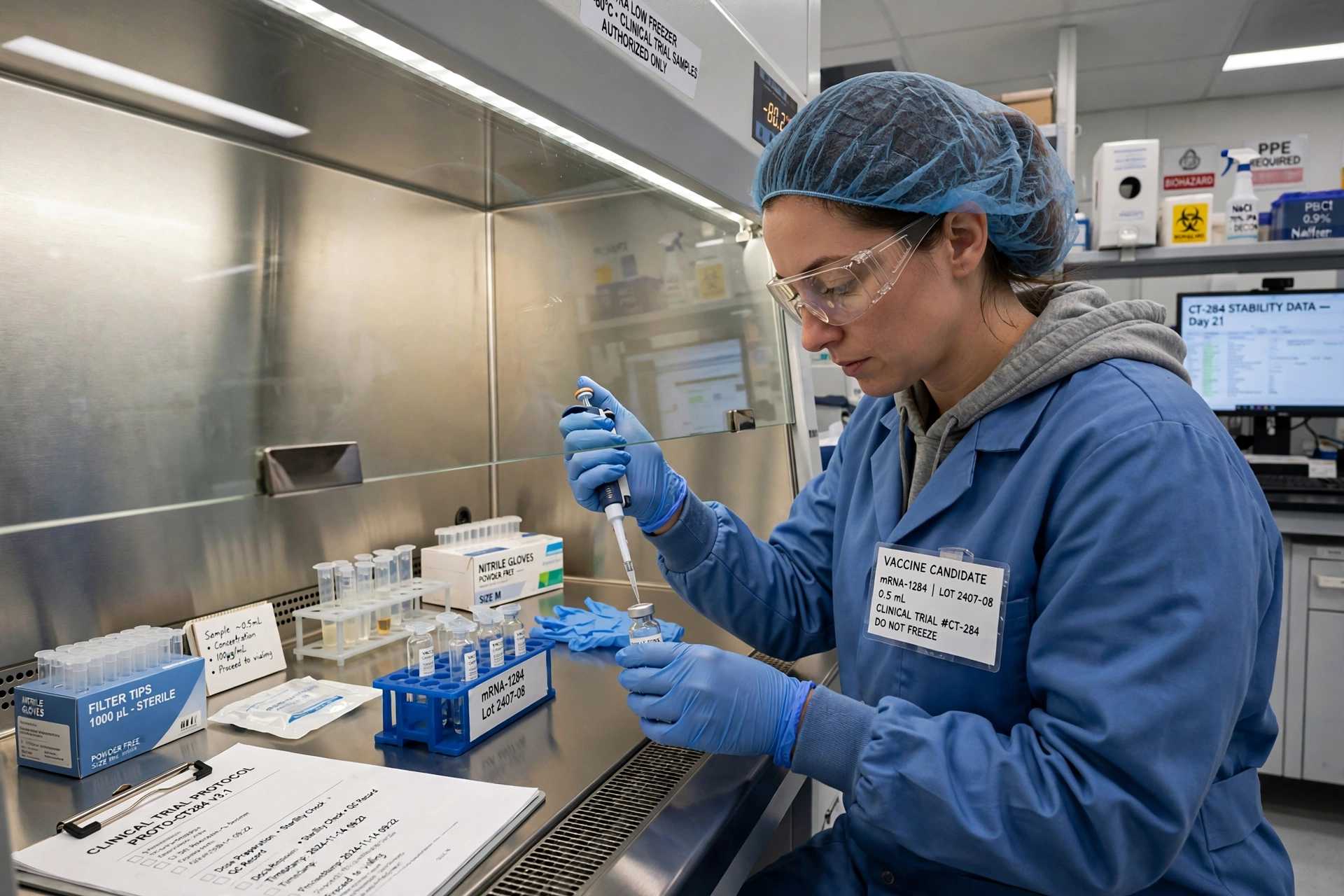
The workflow will sound familiar to anyone who follows applied technology: sequence, predict, build, deliver, measure. It is also unforgiving. Each step must meet clinical standards, and the product is useless if it arrives too late. Showing that the end-to-end process works in trial conditions is the study’s core contribution. Background on the disease is available from the National Cancer Institute.
Adding a checkpoint inhibitor
Nivolumab blocks PD-1, an immune checkpoint that tumours exploit to dampen T-cell attack. On its own, a vaccine teaches the immune system what to target; a checkpoint inhibitor aims to keep the responding cells active once they engage. Researchers combined the two in the hope that instruction and persistence together would outperform either alone — a hypothesis this early study can raise but cannot settle.
Our coverage of medical technology, including advances in breast cancer imaging, returns often to the same theme: combinations of detection and intervention are where progress usually hides, and also where evidence is hardest to untangle.
Three findings, carefully stated
First, feasibility: bespoke vaccines were successfully produced and administered within the trial. Second, safety: side effects were judged acceptable for an early-phase combination study. Third, immunogenicity: laboratory analysis detected T-cell responses, the immune signature the vaccine was designed to produce. The peer-reviewed report appears in Nature Medicine.
Missing from that list, by design, is efficacy. A small phase 1 cohort cannot establish whether tumours respond, whether disease is delayed, or whether patients live longer. It also cannot separate the vaccine’s contribution from nivolumab’s, or from the underlying behaviour of platinum-sensitive disease. Those questions require randomised, larger trials with clinical endpoints.
The harder problem: scale
Even if later trials succeed biologically, personalisation is an operational challenge. Sequencing, prediction and manufacturing must be repeated for every patient, quickly and at a cost health systems can bear. In that sense the NeoVax programme resembles a piece of precision engineering as much as a drug: the product is the process.
The feasibility data therefore matters beyond immunology. Every patient treated on schedule is evidence that a supply chain of biopsies, algorithms and clean-room manufacturing can function under clinical pressure. Weakness anywhere in that chain would limit the therapy no matter how elegant the underlying science.
What patients should take from this
Nothing about standard care changes on the basis of a phase 1 feasibility study. The appropriate response is measured interest: a difficult idea has been executed safely, immune responses were observed, and the case for larger trials is stronger than it was. Researchers at centres that pioneered neoantigen vaccine work now need to show that immune activation translates into outcomes patients can feel.
NeoVax has cleared the first gate — can it be made and given safely? The gates ahead, whether it works and for whom, are higher. That sequence is not a disappointment. It is how reliable medicine is built.

1 Comment
Pingback: Electronic Cigarettes After Quitting Smoking: A Review of Lung Cancer Evidence - Tech Waterfall